Rostock, July 25, 2025
Joint press release by the University of Rostock and the Leibniz Institute for Baltic Sea Research
Warnemünde (IOW)
Innovative pilot project against cigarette waste: “Warnow Ashtrays” go into operation in Rostock’s city harbor
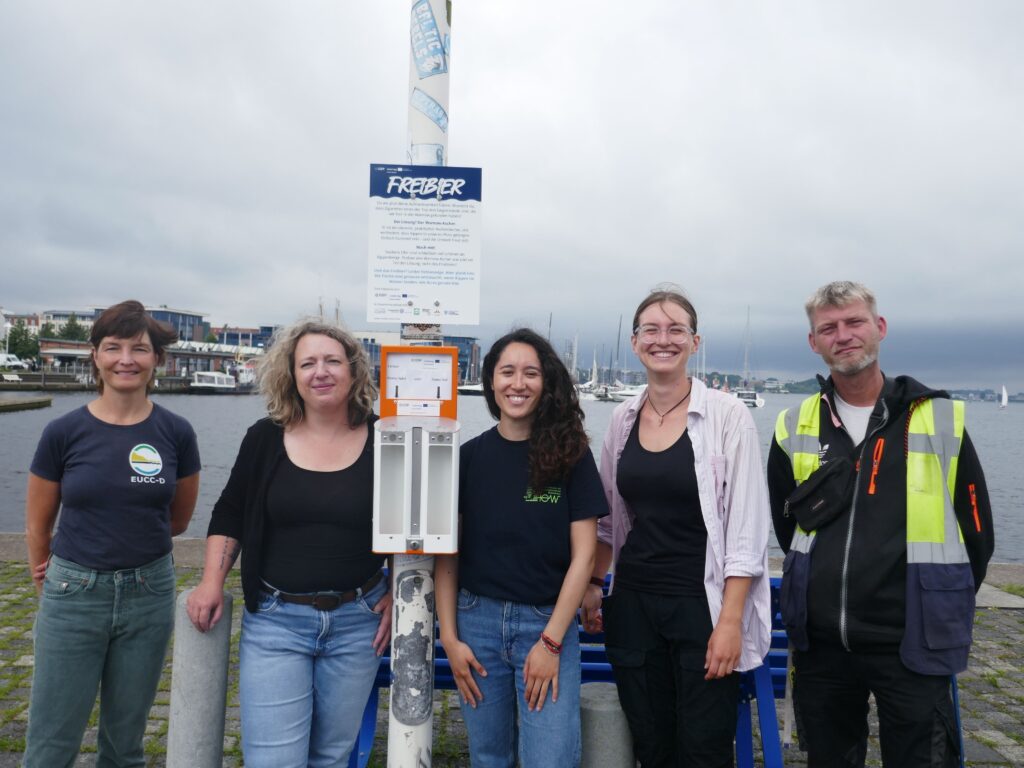
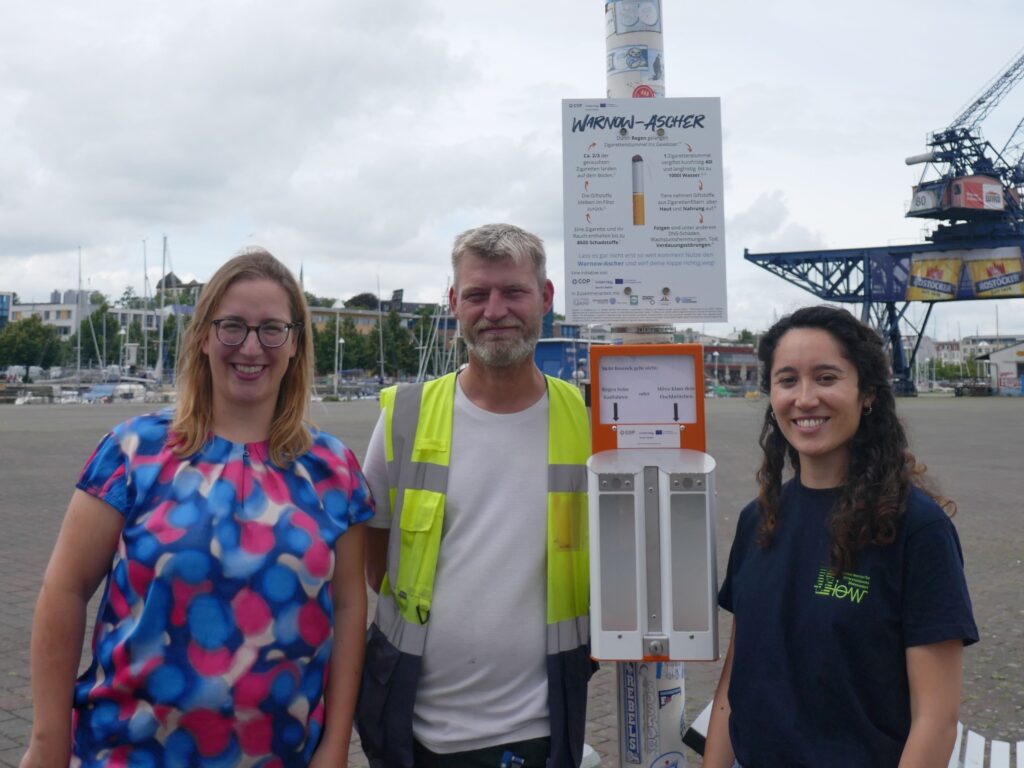
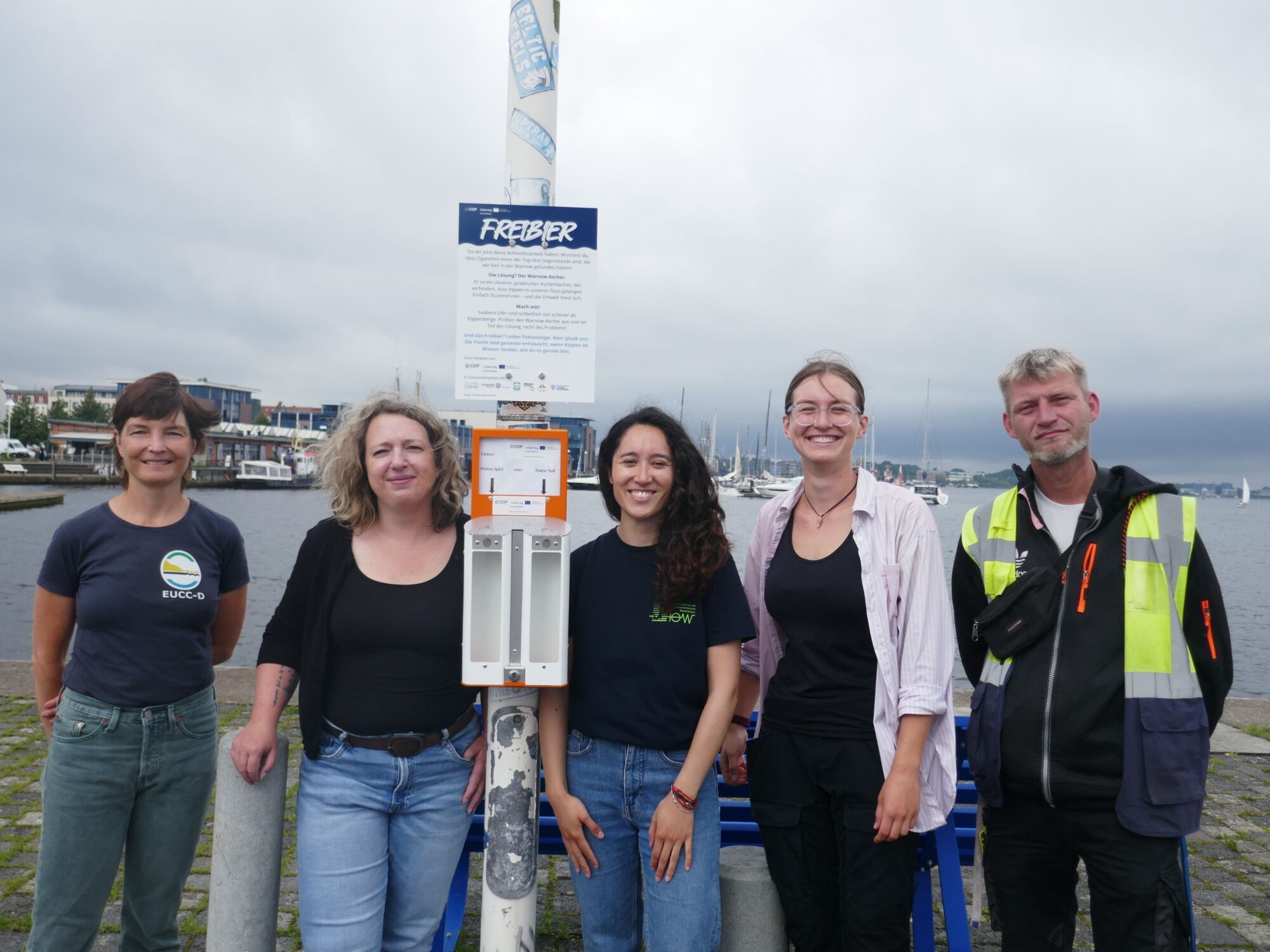
Five special cigarette waste containers – so-called “Warnow Ashtrays” – were installed this week in Rostock’s city harbor between the Am Kabutzenhof ferry pier and the Haedge peninsula. The Warnow Ashtrays are intended exclusively for cigarette butts. The aim is to counteract the environmental pollution caused by cigarette butts and at the same time to gain scientific findings on the effectiveness of the Warnow ashtrays. The measure is part of the international research project Circular Ocean-bound Plastic (COP), carried out by the Leibniz Institute for Baltic Sea Research Warnemünde (IOW) and the University of Rostock.
The installation of the Warnow Ashtrays was prompted by the results of a year of joint research by the IOW and the University of Rostock into plastic waste pollution in the Warnow. This included the use of “portbins” – floating garbage cans that independently collect floating waste in the city harbor before the river washes it into the Baltic Sea. The systematic analysis of the contents after six months of use is clear: 91% of the waste consists of plastic; cigarette butts and packaging are among the most common types of waste on the surface of the water, accounting for around 30%.
“Cigarette filters are made of cellulose acetate, a plastic that degrades very slowly and continuously releases toxins into the water,” explains Mona-Maria Narra, environmental researcher at the University of Rostock. “In addition, packaging and filters decompose over years to form dangerous microplastics, which do not remain in the port but ultimately end up in the Baltic Sea.”
The idea of the Warnow Ashtray was developed in fall 2024 – as a direct response to the study results – as part of a stakeholder workshop at the IOW with participants from science, administration, tourism, the waste and port industries and various NGOs. “Our goal was to develop a practicable measure that would encourage smokers to dispose of their cigarette butts properly at a low threshold and thus prevent toxic cigarette waste directly at the source,” emphasizes Gabriela Escobar Sánchez, expert in marine litter monitoring and sustainable waste management at the IOW. “We consider the cooperative process, in which various stakeholders from research, practice and the public sector are involved, to be a key success factor for the acceptance and thus long-term impact of the measure,” Escobar Sánchez continues. The special ashtrays were therefore installed in close cooperation with EUCC – The Coastal Union Germany, the Rostock Port Authority, the Hanse Sail Office, the waste management office and the Hanseatic city’s tourist office.
The effectiveness of the Warnow ashtrays will now be continuously monitored and scientifically evaluated for a period from June to November 2025. To this end, the research teams involved are analyzing the number of cigarette butts in the port area and comparing areas with and without the Warnow Ashtray installation. In addition, they will record how the amount of butts in the floating portbins has changed before and after the introduction of the Warnow ashtrays in order to be able to evaluate the effect of the measure based on data.
If the ashtrays prove successful, they will become part of an action plan to reduce marine litter, which will also be implemented in other Baltic port cities. The research project is part of the Circular Ocean-bound Plastic (COP) project, which aims to develop and implement innovative approaches to reducing marine litter in the Baltic Sea region and is funded as part of the EU’s Interreg South Baltic program. The partners are institutions from Germany, Poland, Sweden and Denmark.
Scientific contacts:
Gabriela Escobar Sánchez,
Leibniz Institute for Baltic Sea Research Warnemünde (IOW),
+49 (0)381 5197 – 403
gabriela.escobar@iowarnemuende.de
Mona-Maria Narra
University of Rostock, Chair of Waste and Material Flow Management,
+49 (0)381 498 – 3410
mona-maria.narra@unirostock.de
Press contact:
Ida Holmgaard,
Circular Ocean-bound Plastic (COP), Ocean Plastic Forum,
+45 22 98 10 75
ih@oceanplasticforum.dk
Download the press release in English or German below: